Trade · Berlins Today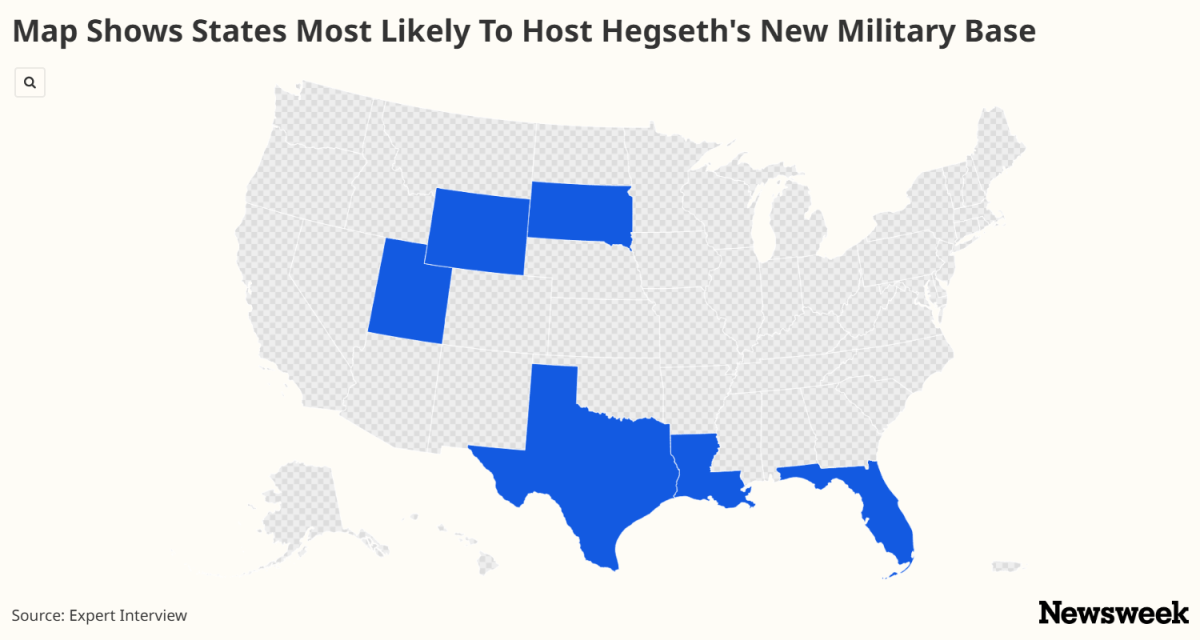
Defense Secretary Pete Hegseth has invited governors and state military officials across the country to make their case for hosting a brand-new U.S. military installation—the first such major new base to be built in decades. During his September 30 "State of the Force" address at Marine Corps Base Quantico in Virginia, Hegseth called on every governor and adjutant general to make the case for why their state should host what he called the "Next Great American Base." "If your state wants the honor of hosting 15,000 to 25,000 of America's great troops, show us why and how you're going to do it—cutting through the red tape, offering up the land and rolling out the red carpet for our military families," Hegseth said. He described it as a "dynamic, self-sustaining power projection platform" with its own power generation, modern air defenses and advanced technology.
But exactly where such an installation could go remains unclear. Katherine Kuzminski, director of studies at the Center for a New American Security, told Newsweek that one of the biggest questions is what Hegseth means by a “base.” The U.S. military has service-specific installations as well as Joint bases, where multiple branches operate together. If the Pentagon intends to create a genuinely joint installation involving the Army, Navy, Air Force, Marine Corps and Space Force, the list of potential locations becomes considerably narrower.
“If it’s a truly Joint base—and there’s an opportunity to bring together all five of the services that doesn’t currently exist,” Kuzminski said, “it will have to be a location that the Navy specifically can operate.” That would favor coastal locations, particularly along the Gulf of Mexico, while a base involving only one or two services could potentially be built much farther inland. Kuzminski said she also believes the Pentagon will be "looking for a community with a proven track record of support for military service, which may be a factor considered." One factor that Kuzminski said she hopes does not play a role, but fears it could, is the state's politics. "The decision should not in any way be based on partisan political leanings, though that may ultimately be a factor that is considered," she said.
Based on those criteria, Kuzminski said six states stand out as locations that could fit different versions of Hegseth's proposal: Texas , Louisiana, Florida , South Dakota , Wyoming and Utah . ... Texas Texas can offer a strong argument to host the new military facility due to its "strong military footprint" and Gulf Coast access, according to Kuzminski. She specifically highlighted Corpus Christi or an area between Corpus Christi and Houston as a possible location.
She ruled out the city of Houston itself. "Houston would provide access to the Gulf, but has too large of a population that would be displaced," she said. Kuzminski said a new installation would need "a lot of available land" and should not be in an area with a large local population, given the displacement and other effects an installation of this size could create.
Texas already has the kind of military infrastructure that could support such an expansion. The state has 15 active-duty military installations, including Naval Air Station Corpus Christi, Naval Air Station Kingsville, Corpus Christi Army Depot and Joint Base San Antonio. Corpus Christi is particularly notable because it already combines multiple military missions.
Naval Air Station Corpus Christi is home to the Navy’s Chief of Naval Air Training and a Navy flight-training wing, while the adjacent Corpus Christi Army Depot is the Army’s largest helicopter repair, overhaul and maintenance center. The installation also hosts Marine aviation personnel and more than 25 tenant commands and activities. That existing naval presence means a Texas proposal would not have to establish a Navy presence from scratch.
It could potentially build around an existing military aviation ecosystem while taking advantage of Gulf access. The challenge is finding enough land and airspace without running directly into the population and development of the state's major coastal cities. Louisiana Louisiana is another state that fits Kuzminski’s Gulf Coast theory.
A Gulf Coast location would also give the military access to extensive over-water airspace for aviation training. Louisiana already has an unusually joint military environment. Naval Air Station Joint Reserve Base New Orleans in Belle Chasse supports active-duty, Reserve and National Guard components and hosts units from multiple branches.
The installation covers about 5,200 acres and has more than 7,000 personnel across 33 tenant commands. Its airfield has two runways, including one that is 10,000 feet long, and it supports training by Navy, Air Force, Marine Corps and other military organizations. That existing experience operating a genuinely joint installation is notable given Kuzminski’s observation that the Pentagon does not currently have a single base bringing together all five services.
Louisiana would still need to identify a much larger, relatively low-population site if Hegseth’s proposal requires hundreds of thousands of acres. Florida Kuzminski also identified Florida as a potential Gulf Coast contender, particularly under a scenario in which the Navy is part of the new installation. Florida already has one of the country's largest concentrations of military infrastructure, including extensive facilities in the Panhandle.
Eglin Air Force Base alone illustrates the kind of airspace and training environment the Pentagon could be looking for. Eglin's range complex includes approximately 726 square miles of land range, 134,000 square miles of airspace and 123,000 square miles of water range, according to Military OneSource. The Air Force says the Eglin Gulf Test Range covers approximately 120,000 square miles of over-water airspace across the eastern Gulf of Mexico.
That is significant because Kuzminski emphasized that a new installation would need substantial airspace—not only for the Air Force, but because all of the military services operate aircraft. "It will also need to be in an area that has a lot of free airspace,” she said, noting that the requirement would apply not only to the Air Force but to the other services because “they operate aircraft.” Florida also has an established Navy presence, including Naval Air Station Pensacola, meaning a Florida proposal could potentially build on existing naval aviation infrastructure rather than creating an entirely new military ecosystem. The state's drawback is that much of Florida is heavily developed, meaning the Pentagon would need to identify a site where a massive new installation could coexist with existing communities and environmental constraints.
South Dakota South Dakota represents a different possibility, if the new installation does not include all five services. “The Army and the Space Force, for example, could be co-located in South Dakota, Wyoming, Utah,” she said. She did not identify a specific South Dakota site or say that the state would be preferable to the other inland options.
There are nevertheless multiple reasons the state could fit that scenario. South Dakota already has a significant military presence centered on Ellsworth Air Force Base. Ellsworth was selected as the first operational base for the Air Force’s B-21 Raider, and the base in September established a new integration detachment as it prepares for the bomber’s arrival.
South Dakota offers another feature relevant to Hegseth's proposal: relatively open territory and airspace compared with heavily populated parts of the country. That could matter for a base designed around extensive aviation or training operations. The state also has an Army presence through the South Dakota National Guard and the Black Hills Army Depot.
That existing military infrastructure could provide a foundation for an expanded Army presence, while the relatively open terrain of the Great Plains could be useful for aviation and training activities. But there is a clear geographic limitation: South Dakota is inland. If the Navy needs a meaningful operational role at the new installation, the state would not satisfy the coastal requirement Kuzminski identified.
Wyoming Wyoming is similarly an inland possibility. The state's existing military infrastructure gives it a strong case. The state is home to F.E.
Warren Air Force Base, one of the country's major nuclear installations, as well as Camp Guernsey, a Wyoming National Guard training installation. Camp Guernsey's installation boundary encompasses about 79,000 acres and includes land acquired for artillery ranges, impact areas and maneuver training. That existing training footprint is relevant to Hegseth’s proposal because Kuzminski said the Pentagon would be looking for more than simply an empty parcel of land.
The installation would need room for military operations, and Wyoming already has experience accommodating large-scale military training away from major population centers. Its relatively low population density could also reduce some of the displacement and airspace conflicts that would arise around a major metropolitan area. But Wyoming has the same fundamental limitation as South Dakota: if the Navy is an essential part of the proposed joint base, its inland location would rule it out.
Utah Utah may have the strongest independent geographic argument among the three inland states Kuzminski mentioned. Utah already contains an enormous military testing and training complex. The Utah Test and Training Range has more than 12,500 square nautical miles of special-use airspace over roughly 2.3 million acres of Defense Department land, according to Hill Air Force Base.
The Air Force describes the range's remote location, large safety footprint and extensive airspace as key parts of its value for testing and training. The range is also used by multiple military services, including Army, Navy and Marine units, in addition to the Air Force. Hill Air Force Base says the UTTR supports large-force training, weapons testing and open-air training, with thousands of sorties conducted there each year.
Nearby Dugway Proving Ground adds another major military installation and an 11,000-foot runway, while the Army and Air Force already use the surrounding region for testing unmanned aircraft, weapons and other systems. That combination—existing Army infrastructure, extensive Air Force testing and training space, enormous airspace and sparsely populated desert—could make western Utah particularly relevant to an Army- or Space Force-oriented installation. Still, she did not identify a specific Utah site or say that Utah would be favored over South Dakota or Wyoming.
And like those states, Utah would become much harder to justify if Hegseth ultimately requires the Navy to have a substantial operational presence. The Key Question: Does the Navy Need to Be There? That may be the single biggest factor separating the six states.
Hegseth's memo calls for a "new, highly hardened joint military installation" within the United States, but the Pentagon has not publicly explained which services would be assigned there. Kuzminski cautioned that the terminology matters. "We don't currently have 'military bases,'" she said.
"We have either service-level bases or Joint bases." She noted that Hegseth could decide that the new installation will be a joint base, but "it's unclear what kind of base—Army, Navy, Air Force, Space Force, Marines—he's proposing." If all five services are involved, then obviously the Navy will need to be located on a coast. That would put Texas, Louisiana and Florida in a fundamentally different category from South Dakota, Wyoming and Utah. If the Navy is not part of the plan—or if its role is limited to shore-based functions—the geographic field becomes much larger.
What Else Did Hegseth Announce? The new base was just one of six major initiatives Hegseth announced during his State of the Force address. The other proposals were: Autonomous Warfare Command: Hegseth announced plans for a new four-star combatant command dedicated to scaling autonomous and robotic capabilities across the joint force.
He said it would have service-like authorities and focus on drones, artificial intelligence and autonomous systems. Project Meridian: Hegseth announced a future-of-warfare project involving SpaceX CEO Elon Musk, Anduril co-founder Palmer Luckey and former House Speaker Newt Gingrich. The effort is intended to identify future technologies and capabilities the military may need.
FORTRESS America: The Pentagon will pursue a plan to make major U.S. military installations more resilient and eventually capable of generating their own power. Hegseth also tied the initiative to strengthening domestic supply chains. America's Corps of Cadets: Hegseth announced an expansion of military officer-development programs at additional colleges, including Hillsdale College, Louisiana State University, Liberty University, Mississippi State University and Tuskegee University.
Office of Religious Affairs: Hegseth announced a new office that will report directly to the secretary and focus on religious support and resources for military chaplaincies. He separately announced plans to cut the number of general and admiral positions across the military by 20 percent. Hegseth said the new target would double the 10 percent reduction he had previously ordered, with the cuts to be completed by January 1, 2027.
He described the move as "accountability and long overdue." The proposal has drawn questions from lawmakers. Republican Senator Mike Rounds of South Dakota said he wanted to understand the rationale before reaching a conclusion, saying, "If it's simply a matter of eliminating a very heavy top, there may be some validity to it, but I want to see it first." How Much Land Would Hegseth's Base Need? Hegseth has not publicly specified how many acres the new installation would require.
The only numerical target he has given so far is the number of troops: between 15,000 and 25,000 service members. However, larger troop numbers do not always correlate with more land. Consider four military centers across the U.S. with varying personnel numbers.
Fort Cavazos, Texas , has 38,000 active-duty military personnel. The Army installation encompasses about 218,823 acres, including more than 196,000 acres devoted to maneuver and live-fire training. Fort Irwin, California , has 4,601 active-duty soldiers, plus approximately 6,565 rotational soldiers.
The National Training Center covers roughly 753,537 acres, much of it devoted to large-scale desert training. White Sands Missile Range, New Mexico , has 350 permanently assigned service members. The enormous test range covers approximately 2.2 million acres and has restricted airspace extending over millions of acres.
Fort Bragg, North Carolina , has 48,775 active-duty soldiers. The installation covers approximately 172,000 acres, with about 146,000 acres dedicated to training. A traditional troop installation with housing, offices, schools and support facilities could occupy dramatically less land than a major training or weapons-testing complex.
Conversely, an installation designed to give several branches extensive room for aircraft, helicopters, ground maneuver and live-fire exercises could require hundreds of thousands of acres. Kuzminski said the question may ultimately be less about finding one enormous uninterrupted parcel than about whether the proposed installation can obtain the land and airspace needed for its mission. The States With the Most Federal Land The federal government owns particularly large portions of states including Alaska, Nevada, Utah, Wyoming, Idaho, California, Arizona, Colorado and New Mexico.
The Bureau of Land Management alone manages nearly 48 million acres in Nevada, about 63 percent of the state's land base. It manages nearly 22.8 million acres in Utah, while Wyoming has about 18.4 million acres under BLM management. New Mexico is another particularly important example.
White Sands Missile Range occupies approximately 2.2 million acres, demonstrating the scale of military land use already possible in a sparsely populated Western environment. But that also illustrates a central problem with simply looking at a federal-land map. The states with the largest federal land holdings are not necessarily the states that would work for every military mission.
A five-service base that requires a Navy component would have fundamentally different geographic requirements from an Army-Space Force installation. A location with enormous amounts of federal land but no practical naval access could therefore be unsuitable for the former while remaining potentially relevant to the latter. Have Any States Made a Bid?
The Pentagon's invitation is only days old, and Hegseth has not announced a shortlist. The department has asked governors and adjutants general from all 50 states to make their case. Hegseth has framed the process as a competition in which states would offer land, infrastructure and support for military families.
As of October 2, there does not appear to be a publicly announced formal bid from one of the six states identified above. And there is another major hurdle: Congress. Kuzminski said Congress has the "authority to authorize new basing decisions—and the budget associated with basing." That means a governor could make a compelling pitch and the Pentagon could identify a preferred location, but the project would still have to navigate the federal military-construction and congressional funding process.
Kuzminski said she believes that pitches will likely follow similar trends to those seen in the competition for Amazon’s HQ 2. "The local governments won’t need to make the case for tax breaks like the private sector does, but I think they’ll need to make the pitch that they’re willing to make the infrastructure investments to make themselves attractive to DoD," she said. "That could be investments in infrastructure (roads, water, power, housing, schools, childcare, health care, mental health care), willingness to embrace the military community, access to meaningful work for military spouses and transitioning service members." Newsweek’s reporters and editors used Martyn, our AI assistant, to produce this story.
Learn more about Martyn here . Contact Newsweek editors on this story: Gabe Whisnant and Gray R. Thomas
Source: newsweek.com