Trade · Berlins Today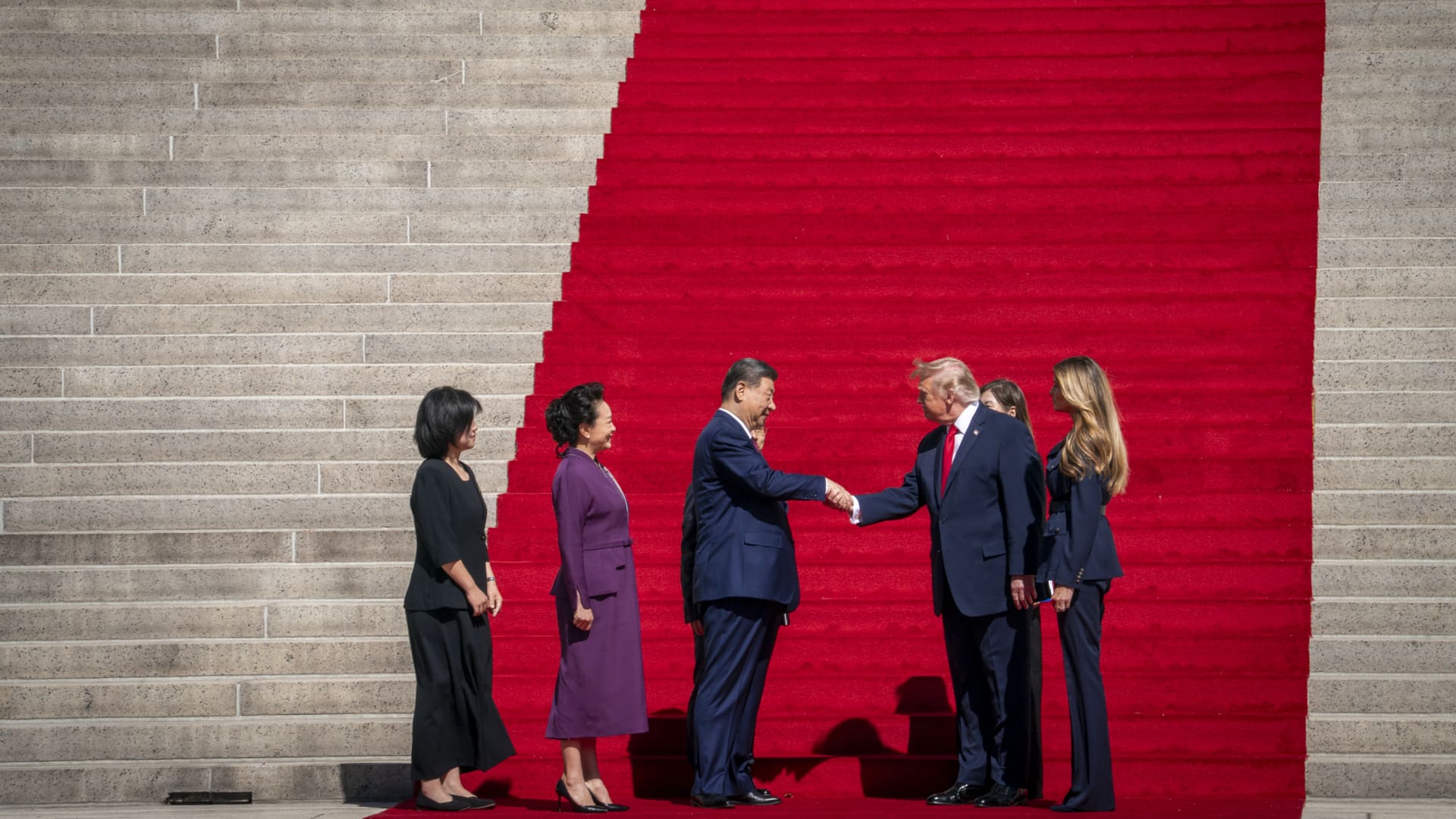
President Donald Trump and first lady Melania Trump pose for a photo with Chinese President Xi Jinping and his wife Peng Liyuan walk down the steps of the National Archives during President Xi Jinping's state visit, Sept. 25 2026, in Washington, DC. The Washington Post | The Washington Post | Getty Images Hi, this is Evelyn, writing to you from Beijing. Welcome to the latest edition of The China Connection — a snapshot of what I'm seeing and hearing from local businesses.
Now that the second Trump-Xi summit of the year is over, it's clear the show was aimed more at home than reaching tangible outcomes . Is agreeing to talk enough? The $30 billion tariff rollback released Monday morning Beijing time reads like the perfect shopping list.
American consumers get to buy cheaper curtains, sports equipment and Christmas lights. Chinese get a discount on U.S. beef, soymeal and other agricultural products. American ice cream is even on the list.
It's the most detailed outcome so far of the summit last week between U.S. President Donald Trump and Chinese President Xi Jinping in Washington, D.C. The official readouts otherwise did not make much headway on major issues, beyond agreeing to keep talking and extending a trade truce — which keeps tariffs lower and rare earths flowing — for another two months.
"Both sides are signaling not to each other, but to their own sides," Cameron Johnson, Shanghai-based senior partner of consultancy Tidal Wave Solutions, told me on Monday. "The reality is neither side can do a whole lot in technology without the other," he said, "so it's important that both sides signal that to their own apparatus: It's OK to have some competition." Over the weekend, The Information reported , citing sources, that the Chinese government has signaled it could allow some domestic companies like ByteDance and Alibaba to buy Nvidia's chip built for high-end professional computers. While the U.S. has agreed to let Nvidia sell some less advanced chips to China, there have been few signs that Chinese companies were allowed to buy them amid Beijing's push for self-sufficiency.
In Beijing's readout of talks with Trump, Xi acknowledged "healthy" competition with the U.S. was possible, without confrontation. Both countries have planned discussions on AI in coming weeks. "I think the top priority for both leaders is to maintain domestic stability and prosperity," said Hai Zhao, a director of international political studies at the Chinese Academy of Social Sciences, a state-affiliated think tank.
"And if the two top economies are stable and growing, that is, I think, the best contribution to global stability and prosperity," he told me on Friday. Both countries are seeing growth concentrated in tech-related sectors, also known as the "K-shaped" economy. AI's development poses the same risks to jobs and national security.
The U.S. and Chinese readouts also signaled some alignment on limiting Iran's nuclear weapon capabilities, and agreed "no country or institution can be allowed to impose tolls on international waterways." "Even though China [and the] U.S. may have different strategic goals in different regions, however, from time to time, they share the same mutual interest," Zhao said, pointing to the need for stable trade flows through the Strait of Hormuz and the Red Sea. "In many ways they can working towards the same goal by not necessarily working with each other," he said. "I call this passive cooperation." Zhao also hopes U.S. and European scrutiny on China's exports can be resolved by encouraging Chinese companies to invest.
While the U.S. and China have released more details on the Board of Trade, less is yet known about the Board of Investment. The question is whether it will get enough airtime in a packed political calendar. Trump faces the midterm elections in early November.
Xi will oversee a plenary meeting in late October aimed at unifying the ruling Communist Party of China. The two presidents are also planning to meet: in Shenzhen in November and in Miami in December. "After eight turbulent years spanning trade war 1.0 to trade war 2.0, signs of stability carry real weight for domestic audiences and entrepreneurs, who are concerned about external environment," Macquarie's Chief China Economist, Larry Hu, said in a report Sunday.
"In reality," he said, "the U.S.–China relationship also anchors much of China's broader diplomacy with the rest of the world." China posts weakest industrial profit growth this year China's industrial profits grew 4.2% in August from a year earlier, official data released Monday showed. China saw 'surprise' jump in U.S. orders ahead of Trump-Xi summit, private survey shows American businesses ramped up orders for Chinese goods in the weeks leading up to the Trump-Xi summit last week, according to a private survey by U.S.-based research firm China Beige Book. Chinese AI models surge in global popularity — and Washington is worried Chinese AI models have rapidly gained traction in 2026, with their token usage surging on developer platforms OpenRouter and Vercel.
Sept. 30: Official PMI, RatingDog China Manufacturing and Services PMI Oct. 1: Hong Kong market closed for public holiday. Oct. 1 - 7: National Day "Golden Week" holiday in China. Mainland stock exchanges closed .
Source: CNBC